
How to Tell the Difference Between Gagging and Choking
Your baby takes a bite of toast. They go red. There's a dramatic cough, a splutter, maybe a horrible retching noise, and your heart is in your throat before you've even had time to think.
Is this choking? Should you do something? Should you grab them?
If you've been through that moment, this article is for you. Because there's one thing that, once you know it, will change every mealtime for the better.
The one thing to remember
Gagging is noisy. Choking is silent.
That's the most important sentence in this whole article. If your baby is making noise, coughing, spluttering, crying, gagging loudly, their airway is not blocked. Their body is doing exactly what it's supposed to do. The noise itself is the reassurance.
When you're in a scary moment and can't remember anything else, ask yourself one question: can I hear my baby? If yes, that's usually all you need to know.
Choking is different. A baby who is choking cannot cough, cannot cry, and cannot make much sound at all, because something is blocking the airway. That silence, combined with visible distress and an inability to breathe, is the signal to act.
Most parents never experience true choking. But almost every parent whose baby does baby-led weaning will experience gagging, sometimes a lot of it, especially in the early weeks. Understanding the difference is genuinely one of the most useful things you can do before you start — along with getting a full picture of what baby-led weaning involves if you're still in the early stages.
What gagging actually is
Gagging is a reflex. Babies are born with a gag reflex that sits much further forward in the mouth than in adults, specifically to protect them while they're learning to manage food. When something triggers it, the body tries to move that food forward and out, and that process is loud and dramatic and can look absolutely terrifying even when nothing has gone wrong.
When a baby gags, you'll typically see their eyes water, their face go red, and food come lurching forward. They might make a retching sound or cough hard. Then, usually within a few seconds, they recover, look mildly surprised, and carry on. That whole sequence, however alarming it looks, is the reflex working exactly as it should.
Gagging is extremely common when babies first start solid food. It doesn't mean the food was wrong, the piece was too big, or that you've done anything incorrectly. It means your baby is learning, and their body is handling it.
What to actually do when your baby gags
The hardest thing in that moment is to stay calm and do nothing, but that's exactly what's needed. Let your baby cough. Let them work it out. Don't put your fingers in their mouth, as this can push food further back or interrupt the reflex that's trying to clear it. Don't pat their back vigorously or pull them forward sharply. Just watch, stay close, and resist the urge to intervene.
Your baby's body already knows what to do. What it needs from you is space to do it.
What to do if your baby is actually choking
If your baby goes quiet, can't cough, can't cry, and looks like they're struggling to breathe you need to act straight away. Lean them face-down along your forearm with their head lower than their chest, and give up to five firm back blows between the shoulder blades using the heel of your hand. If that doesn't work, turn them over and give up to five chest thrusts. If you can't clear the blockage, call 999.
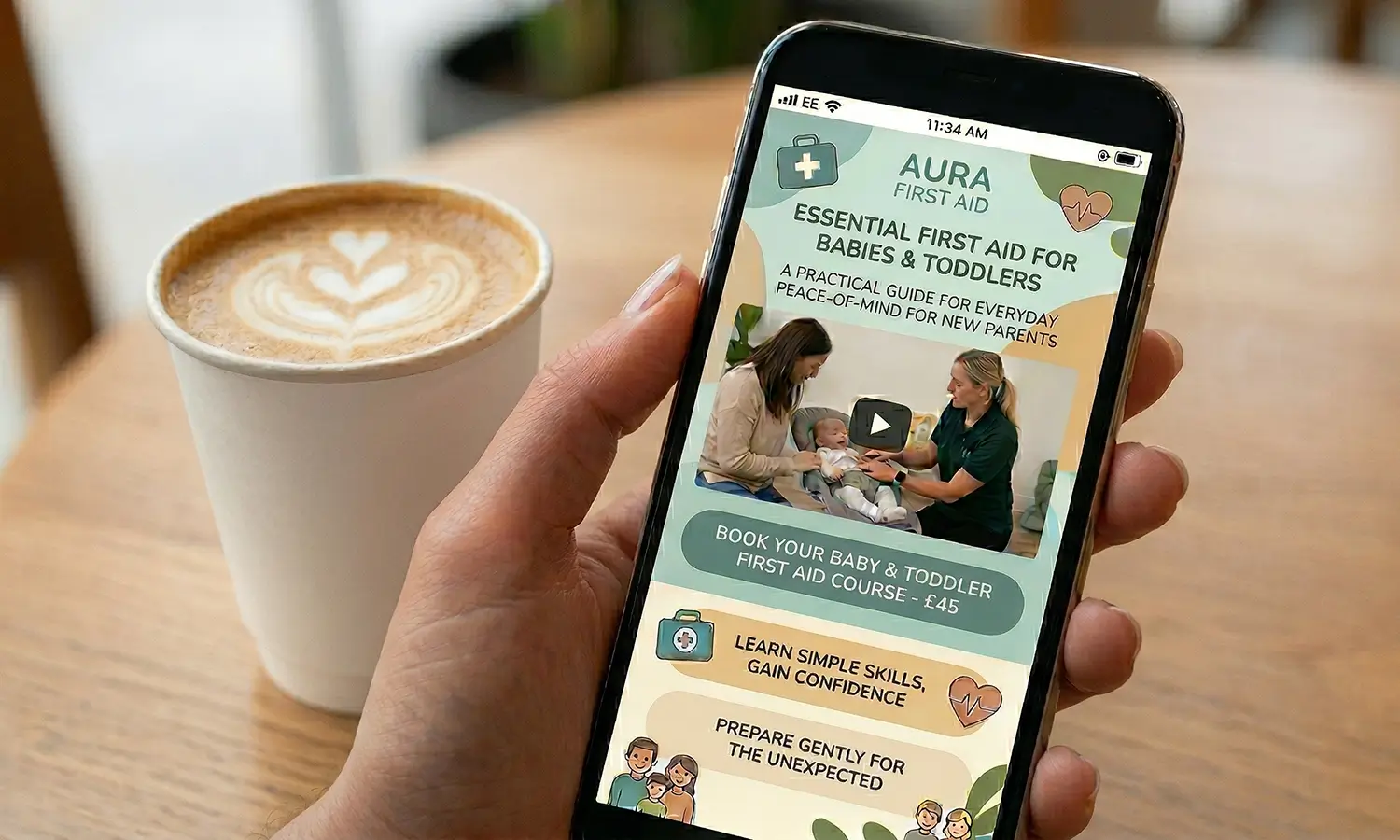
This is worth practising in advance, not because it's likely to happen, but because knowing the steps means you won't freeze if you ever need them. The British Red Cross, St John Ambulance, and the NCT all offer infant first aid courses, and even watching a short video online can make a real difference to your confidence. Your health visitor can point you towards local classes too.
Which foods are actually higher risk
Most soft foods carry very little choking risk. The ones that warrant real care are hard, round, or don't break down easily. Whole grapes and cherry tomatoes are the classic example: their shape and firmness makes them dangerous even for older children. Whole blueberries, hard chunks of raw apple or raw carrot, large spoonfuls of very thick peanut butter, and whole nuts all need care too. Dry foods like rice cakes are worth watching as well, since they can turn into a sticky paste in the mouth that some babies struggle to manage.
The simple test: if you can easily squash it between your fingers, it's soft enough. For anything round, cut it lengthways rather than into circles. Make sure your baby is sitting upright throughout the meal, and always stay with them while they eat, not hovering anxiously, just present.
Foods like ripe banana, steamed carrot sticks, broccoli florets, scrambled egg, soft flaked fish, and toast fingers are all easy to manage and low risk, which is why they make such good starting points. Our guide to first foods for baby-led weaning has more on what works well in these early weeks.
One mistake a lot of parents make
When a baby gags, the instinct is to reach in and pull the food out. It makes complete sense: you can see the problem and you want to fix it. But this almost always makes things worse. Putting a finger in a gagging baby's mouth can push food further back, interrupt the reflex that's clearing it, or cause a small injury if your baby bites down. The gag reflex is doing its job. It doesn't need help.
Stay calm while keeping an eye on your baby and let it pass. Most of the time it's over in seconds.
After a scary moment
If your baby has just had a big gagging episode and you're reading this shaky and wide-eyed, they're okay. That noise, that redness, that dramatic splutter, that was their body working. You didn't do anything wrong. This is what the beginning of weaning sometimes looks like, and it does get easier as their reflex matures and they get better at managing food.
If a scary moment knocks your confidence and your baby seems to go off food for a while, it helps to know what's normal when a baby starts refusing food. And if you're just getting started and want to feel more prepared, our guide to starting baby-led weaning walks through what to expect in those first sessions.