
My Baby Is Refusing Food: Is This Normal?
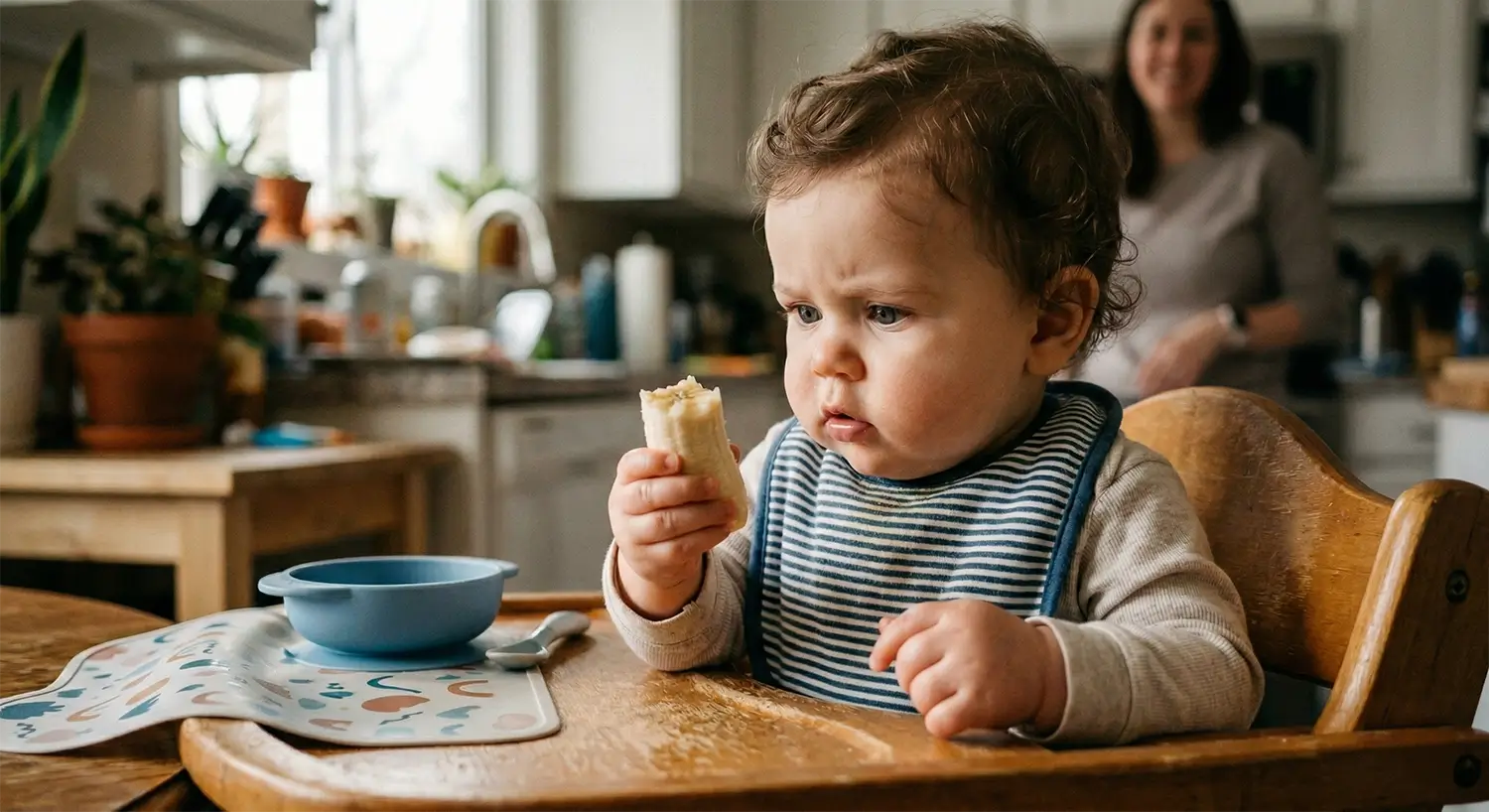
You've cut the banana into little fingers. You've steamed the carrot sticks. You've set everything up on the tray with genuine hope, and then your baby picks up a piece of avocado, examines it like it's mildly offensive, drops it on the floor, and looks at you as if to say: was there something else?
If you're sitting there wondering whether something is wrong, whether you're actually doing it wrong, or whether this means your baby is somehow behind, this is for you.
First, most babies don't really "eat" at six months
At six months, eating isn't really the point. Baby-led weaning is about exploring, not eating — and holding onto that makes these early weeks a lot less stressful. Your baby has been on a diet of milk for their entire existence. They have no concept of food as food. The whole thing, the texture, the smell, the fact that you're putting something in front of them and apparently expecting them to know what to do with it, is completely new information.
What looks like refusal is almost always exploration. They're not saying no to broccoli. They're figuring out that broccoli exists. Throwing it, squishing it, licking it once and then ignoring it, that's all part of the process. It's learning, just not the kind that looks like eating.
Milk is still the main food
This is probably the most reassuring thing to hold onto when mealtimes feel pointless: milk is still your baby's main source of nutrition at this stage. Whether you're breastfeeding or formula feeding, it's still giving them the calories, fat, and nutrients they need to grow. Food is genuinely just practice right now, and fun too! There's no nutritional gap being left if your baby eats almost nothing at six months, or seven months, or even a bit beyond that.
When your baby takes one lick of sweet potato and calls it a day, they haven't missed a meal. They've had a weaning session. That's a different thing.
The comparison trap is real, and it's not helpful
One of the hardest parts of this stage is watching other babies apparently polishing off bowls of pasta while yours is still using toast fingers as a hairbrush. It can feel like everyone else's baby is doing it better, or faster, or more enthusiastically.
The range of normal here is genuinely enormous. Some babies dive in at six months and eat with gusto from week one. Others take weeks to show any real interest, and some don't consistently eat much until well past nine months. All of that falls within normal development. Eating early isn't a sign of a more clever baby or better parenting, and eating later isn't a sign of a problem. It's just how it goes.
What progress actually looks like at this age
If you're measuring success by whether your baby ate a proper portion, you'll feel like you're failing every single day. Progress at this stage looks much smaller than that, and it's worth watching and observing the tiny amounts of progress as they happen. Our free weaning chart can help you spot patterns you'd otherwise miss.
A baby who picks up a piece of food and brings it to their mouth has made progress. A baby who takes one tiny bite and spits it out has still experienced a flavour. A baby who spends ten minutes squishing some banana into the tray is learning about texture, temperature, and what their hands can do. None of that is wasted. It's all building towards the point where eating actually happens — and keeping those early plates simple removes one less thing to worry about. You just can't always see the progress in real time.
What about when they seem to have no interest at all?
Some babies go through phases of showing almost no interest in food, even after a promising start. This can be down to tiredness, teething, the start of a cold, or simply an off day. Keeping mealtimes low-pressure and fairly short, ten to fifteen minutes is plenty, means there's no big battle to lose and nothing to dread on either side.
Letting your baby eat alongside you, if you can, genuinely helps. Babies are excellent at copying, and watching you actually eat something often sparks more interest than any amount of carefully prepared food on a tray. It doesn't have to be a special occasion. Even just having them in the room while you eat lunch can make a difference over time.
What helps most is often consistency rather than strategy. Seeing food again and again, touching it again and again, sitting at the table again and again, this is what slowly makes it feel familiar. Not one magical food, and not a perfect routine. Despite what social media shows you! We talk more about structuring early mealtimes in our guide to starting baby-led weaning.
A note on pressure
Trying to encourage a baby to eat more than they want to, putting food in their mouth, showing obvious stress at the table, turning each meal into an event, tends to make things harder, not easier. Babies are remarkably good at picking up on anxiety around food, and mealtimes that feel tense become things to resist rather than enjoy. The more ordinary and relaxed you can keep it, the better things tend to go long-term.
Sometimes parents feel they need to fix the problem. But often there isn't a problem to fix, just a stage to move through.
Put the food out, sit with them, eat something yourself if you can, and try to let the rest go. It's one of those parenting situations where doing less genuinely achieves more.
When should I mention it to my health visitor?
Food refusal in the first few months of weaning is, the vast majority of the time, completely and boringly normal. A few things are worth mentioning to your health visitor: if your baby isn't gaining weight as expected, if they're still showing very little interest by around nine or ten months, or if they seem to struggle with any texture at all rather than just being slow to warm up. In those cases, it's worth a conversation, not because something is definitely wrong, but because a health visitor can help figure out whether any extra support would be useful.
For the vast majority of tired parents reading this at six or seven months: you're not doing it wrong. Your baby will eat. It just takes longer than anyone tells you it will.