Introducing Allergens to Your Baby: How to Do It Without Fear
You've got the peanut butter out. Or maybe it's an egg. You're about to offer it to your baby but then you stop. What if they react? What if you get this wrong? What if you're the one who causes your baby a reaction?
A lot of parents sit with this fear for weeks, quietly avoiding the foods that worry them most. It makes complete sense, especially when you're still getting your head around how baby-led weaning works generally. But there's something important to know before that fear puts you off.
You don't cause allergies by introducing foods
This is the bit that surprises most people: introducing allergens early doesn't trigger allergies. Current evidence suggests the opposite in fact. Introducing common allergens during the weaning window may actually help reduce the risk of your baby developing one. Avoiding these foods doesn't protect your baby, it's now found that in most cases, gentle early introduction is what helps.
This is also why advice has shifted so much in the last twenty years. If a grandparent or older relative has told you to avoid peanuts or delay eggs, they're not wrong to remember that as it was the guidance for a long time. But newer research changed the thinking significantly, and current NHS advice now recommends introducing allergens early rather than holding off.
Which foods are we actually talking about?
The main allergens flagged in weaning advice are eggs, peanuts, tree nuts (like cashews and almonds), dairy, wheat, fish, shellfish, and soy. Written out like that, the list can certainly look alarming. But the vast majority of babies tolerate all of these completely fine. Allergies are real and do happen, but they're much less common than the level of fear around this topic might suggest.
How to actually introduce them
No complicated system or special schedule needed. Introduce one new allergen at a time, offer a small amount to start, do it at home rather than just before nursery or a long trip out, and keep it to daytime so you can watch your baby for a couple of hours afterwards.
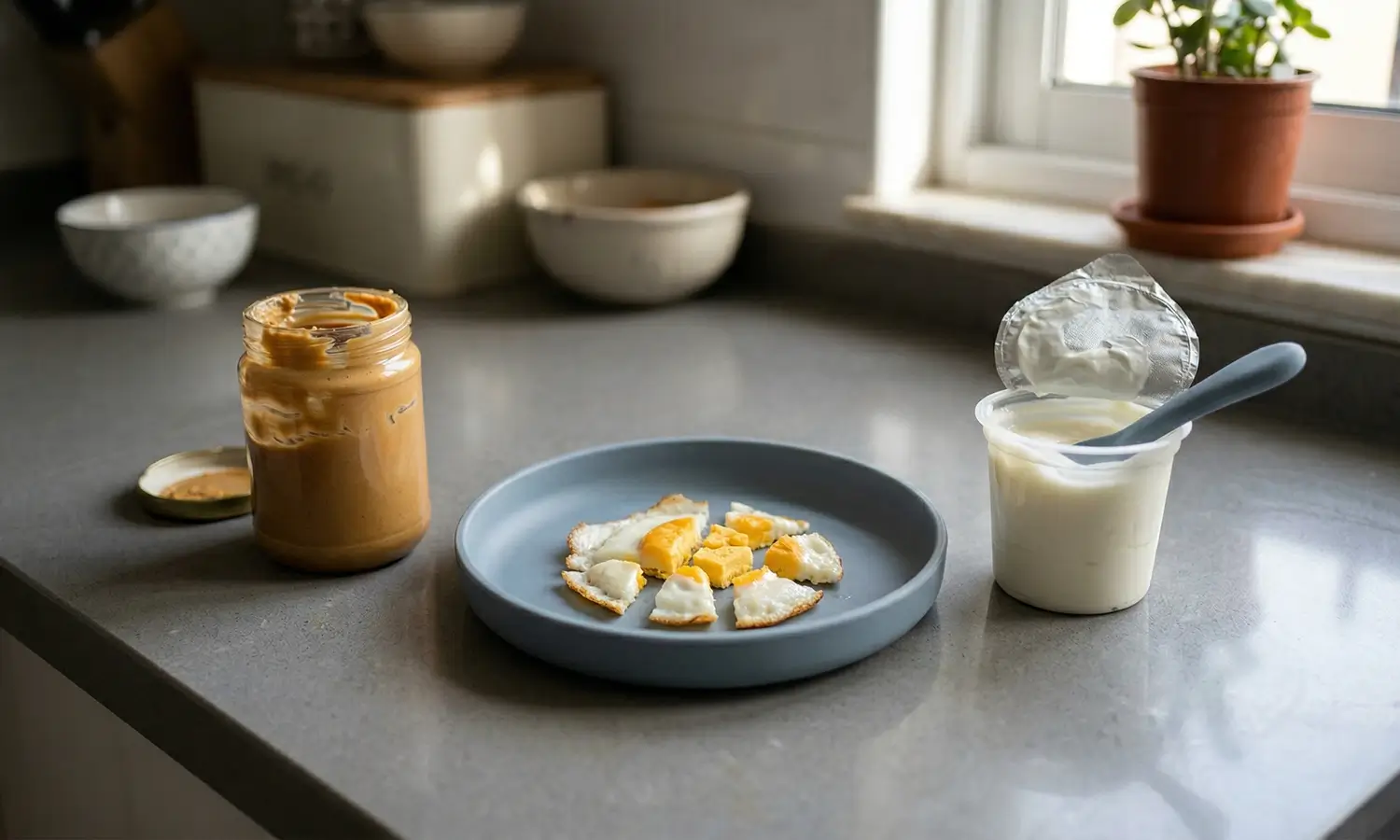
A thin scrape of smooth peanut butter on a toast finger. A small amount of scrambled egg. A spoonful of full-fat yogurt. You're not serving a full portion, just giving a taste and seeing how they go. If nothing happens, brilliant. Then the bit that really matters: keep offering it regularly. One small exposure followed by months of avoidance isn't the goal. Regular inclusion at your baby's mealtimes is what seems to make the difference.
What does an actual allergic reaction look like?
A genuine allergic reaction is usually obvious - you're looking for swelling, particularly of the face, lips, or eyes, hives or a raised rash spreading across the body, vomiting, or in more serious cases, difficulty breathing or signs of distress. These reactions tend to come on quickly, usually within an hour or two of the food, and they're hard to miss.
What they don't look like is your baby pulling a face, gagging on a new texture, coughing as they learn to manage food, or getting a small patch of redness around their lips. All of those are completely normal parts of learning to eat and have nothing to do with allergy, even though they can look alarming when you're on high alert.
Babies can also get a mild, flat redness around their mouth from contact with slightly acidic foods like tomato or strawberry. This is the food touching the skin, not an allergic reaction. It looks different from hives and fades quickly.
Gagging in particular is very normal in baby-led weaning and nothing to do with allergy. We cover the difference between gagging and choking properly in our guide to gagging and choking.
What if there are allergies in the family?
A family history of allergies, whether eczema, asthma, hay fever, or a known food allergy, does mean your baby has a slightly higher chance of developing one too. It doesn't mean they will, and it doesn't mean you should avoid introducing allergens. Early introduction is still recommended, even for higher-risk families.
You might want to be a little more careful about timing, introducing allergens at the start of the day rather than right before bed, for example, so you have more time to observe. If you're particularly concerned, a quick chat with your GP or health visitor before you start can help reassure you. What's not recommended is skipping these foods altogether, because that approach is more likely to increase risk, not reduce it.
A word on peanuts
Peanuts tend to carry the biggest fear, so they're worth a mention on their own. The main practical rule is simple: never give whole peanuts to a baby or young child, as they're a significant choking hazard. Smooth peanut butter is fine and easy to use, spread thinly on toast or mixed into a bit of porridge. If the texture feels too thick, thin it with a little breastmilk, formula, or warm water. A small amount on a toast finger is one of the easiest allergen introductions there is, and for most babies, absolutely nothing happens.
You can do this
The hardest part for most parents isn't the practical side. It's getting past the fear enough to try. Once you've introduced a few allergens and your baby has sailed through without any reaction, it tends to feel much less frightening. By then you'll likely be in a good rhythm with mealtimes — our guide to those first sessions can help if you're not there yet. Looking back, most parents say the same thing: they were more worried than they needed to be.
If you're still working out what to offer in these early weeks, our guide to first foods for baby-led weaning has plenty of simple ideas to get you started.